



History Events DA
Start:
Start
Av. Prof. Luciano Gualberto, 315
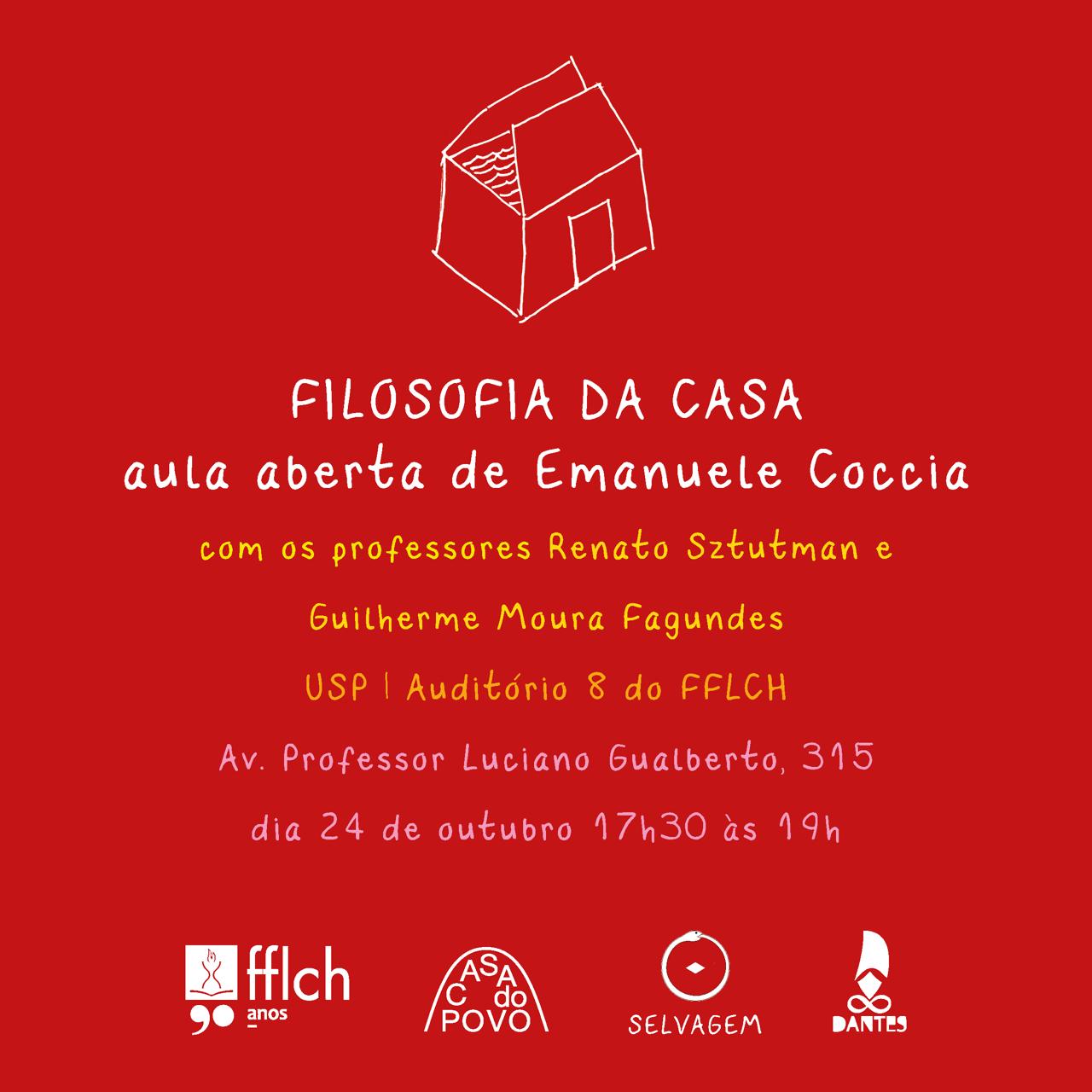
In “Filosofia da Casa”, Emanuele leads us, through an intimate and delightful narrative, to explore living rooms, bedrooms, kitchens, bathrooms and memories, presenting the home as a place of connection with the world and with ourselves. The book, which has a foreword written by anthropologist Júlia de Sá Earp and illustrations by Luiz Zerbini, unfolds the experience of Metamorphoses (Dantes, 2021) proposing, this time, to enter the cocoons to, finally, resignify them.
Professors in charge: Renato Sztutman (FLA) and Jean Tible (FLP)
Mediation: Professors Renato Sztutman and Guilherme Fagundes.
The open class precedes the launch of the book Filosofia da Casa, which will take place at Casa do Povo, on 10/26. See I adopt.

Start:
Start
Rua do Anfiteatro, 181 - favo 8, Cidade Universitária, São Paulo - SP
Meeting with Edilene Coffaci de Lima (UFPR) at CEstA/USP, Thursday, 10/24/2024, at 5:00 p.m.
There is extensive documentation about the Xetá, an indigenous group that speaks the Tupi-Guarani language and was officially contacted just over 70 years ago in northwestern Paraná: from the Indian Protection Service (SPI), the Anthropology Department of UFPR, the Museu Paranaense, the Círculo de Estudos Bandeirantes, among other archives. I will present how research has been conducted based on the records of these institutions and others yet to be explored, such as the Minor Order of Capuchin Friars, as well as the Chambers and City Halls of municipalities that were built on their lands.
CEstA - Center for Amerindian Studies
Rua do Anfiteatro, 181, Colmeia - Favo 8
Cidade Universitária

Start:
Start
Room 14 of the Social Sciences Building - Av. Prof. Luciano Gualberto, 315
Start: Friday, October 18, 2024, 5:00 p.m.
Location: Room 14 of the Social Sciences Building - Av. Prof. Luciano Gualberto, 315
With joy, Sexta do Mês invites everyone to the thematic table that will take place in October.
In the month in which the uninterrupted genocide against the Gaza Strip completes one year, the October edition of Sexta do Mês opens space for reflection on the experiences of exile, forced displacement and agency of the Palestinian people. In light of the new work by anthropologist Leonardo Schiocchet, entitled “Processes of Belonging and Social Organization among Arab Forced Migrants: Theoretical and Methodological Contributions”, published in 2024 by the Brazilian Anthropology Association (ABA) and Editora Fi, we propose the exercise of articulating ethnographic knowledge with the contemporary political scenario of the Middle East. The colonial occupation of Palestine, which began more than seven decades ago, is entering a new phase of violence and dispossession of the Arab-Palestinian population and, far from ending, is expanding to countries such as Lebanon, Iran and Yemen.

Start:
Start
Room 8 of the Social Sciences Building - Av. Prof. Luciano Gualberto, 315
The Ethnographic Laboratory of Technological and Digital Studies (LETEC) and the Center for Studies on Social Markers of Difference (Numas) invite you to the launch and debate event for the book "We Need to Talk About Consent".
The debate will be held between the three authors: Arielle Sagrillo, Beatriz Accioly Lins and Silvia Chakian.
The book proposes a more detailed and qualified discussion on the concept of consent, central to various contemporary situations, and from different disciplinary perspectives.
The event will take place on October 18th, at 10 am, in Room 8.

Start:
Start
Sala 24 do Prédio das Ciências Sociais - Av. Prof. Luciano Gualberto, 315
The proposal for the Meeting of Knowledges Seminar at USP was developed by the Pro-Rectory of Inclusion and Belonging (PRIP), the Institute of Psychology (IP) and the Laboratory of Psychoanalysis, Society and Politics (PSOPOL), in dialogue with professors and researchers from several units and universities (IP/USP; FFLCH/USP; PROLAM/USP; IB/USP; FFCLRP/USP; DAN/UnB; Transversal Training Program in Traditional Knowledges/UFMG; FCM/Unicamp; Kaapora/Unifesp; Xingu Project/Unifesp; ICH/UFJF).
The Seminar will promote contact between the academic community and interested parties with traditional knowledge from the teachers present (from some Afro-diasporic and indigenous traditions).

Start:
Start
Period:
Period
10/14/2024 to 10/18/2024
LISA Auditorium. Rua do Anfiteatro, 181, Favo 10, USP.
Center for Anthropology, Performance and Drama (NAPEDRA/USP)
Center for Afro-Brazilian Arts at USP
Hybrid Event
Link to all sessions: https://meet.google.com/huf-vvvo-ckh
Schedule
October 14 (Monday)
– Online schedule via Zoom
● Afternoon (2:00 p.m.):
o Welcome from the organizing committee
John C. Dawsey, Pâmilla Vilas Good morning, Fernanda Marcon.
○ Canoe Path: between mirrors and water roots (conversation circle)
Carlos Corrêa Praude (UNB) Rita de Almeida Castro (UNB; NAPEDRA/USP) (remote).
○ Falling Bodies: A film, a massacre, a cyborg and the spiraling time of performance
Scott Head (GESTO/UFSC) (remote)
○ Around the World (Short Film Screening, 14’12)
Alice Villela (NAPEDRA/USP) (remote)
○ Andanças de Fé (Documentary Screening, 46’)
Carlos Alberto Corrêa Moro (UNICAMP; NAPEDRA/USP) (remote)

Start:
Start
Room 1037 of the Social Sciences Building - Av. Prof. Luciano Gualberto, 315
Inhabiting fires
Monday, October 14 at 2:00 p.m. - Room 1037
The presentation will be based on the way in which the quilombolas of Jalapão (TO) inhabit the general environment. Instead of establishing static borders, buildings, and individualizing possession, it is a way of living that is expressed through wandering activities in areas with different temporalities of post-fire regeneration. In addition to demonstrating how this way of living broadens our understanding of the conditions of habitability at the time of large forest fires, the presentation will also seek to outline an ethnographic theory of quilombola freedom. In short, it is an experience of freedom that cannot be reduced to ecological autonomy, since it is guided by demands that are more than human, the effects of which have repercussions on a way of relating to fire that goes beyond its control.
Start:
Start
Room 24 of the Social Sciences Building - Av. Prof. Luciano Gualberto, 315
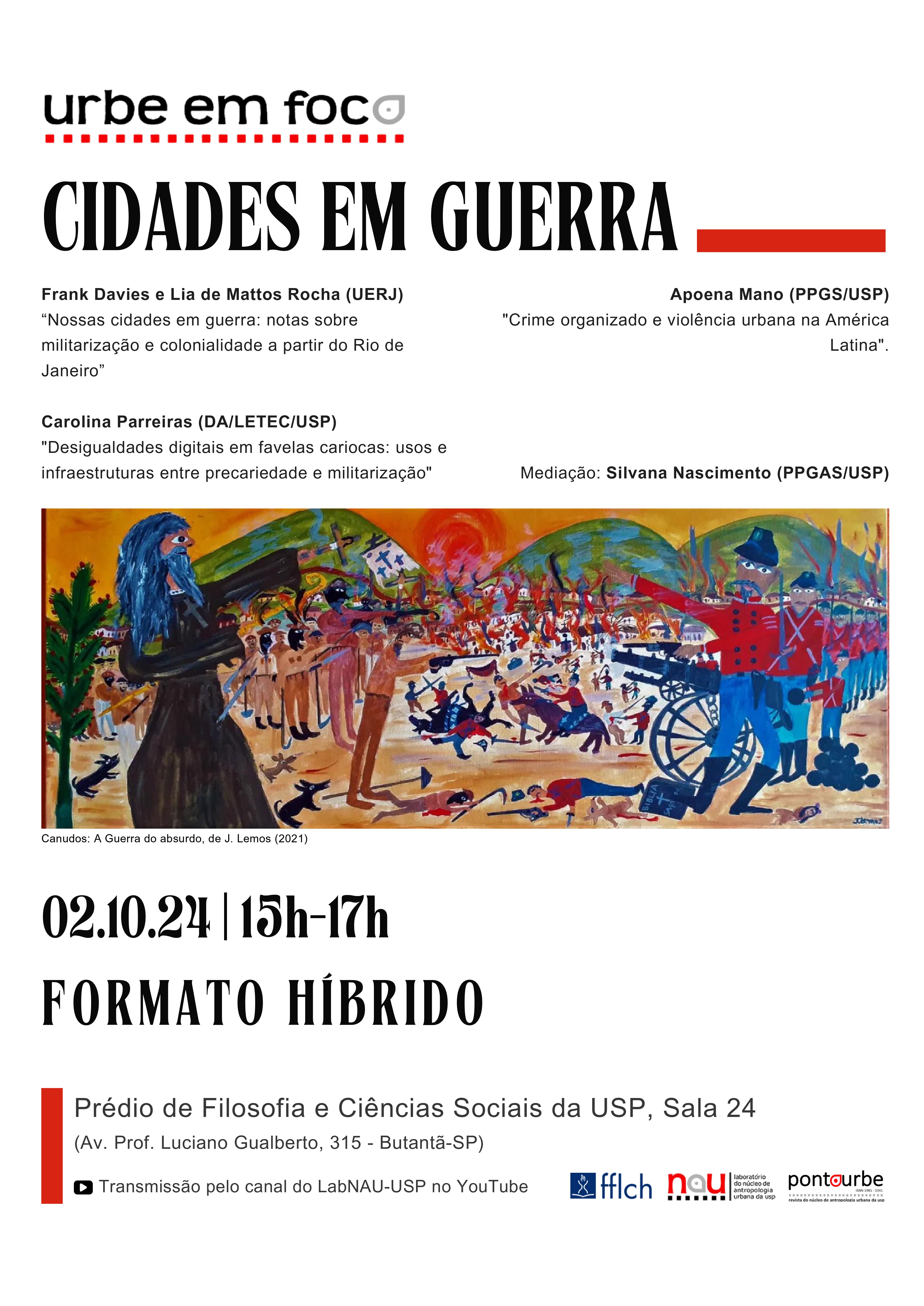
The Ponto.Urbe magazine, a periodical linked to the Laboratory of the Center for Urban Anthropology at USP, announces Urbe em Foco VII! Next Wednesday, October 2nd, starting at 3:00 p.m., in the Anthropology Auditorium (Room 24) of the Social Sciences and Philosophy Building (FFLCH), we will discuss the dossier “Cities at War”, published in our latest issue. Participate! No prior registration required. Certificates will be issued for in-person participants. Check out the participants: Frank Daves and Lia de Mattos Rocha (UERJ) Our cities at war: notes on militarization and coloniality from Rio de Janeiro Carolina Parreiras (DA/LETEC/USP) Digital inequalities in Rio de Janeiro's favelas: uses and infrastructures between precariousness and militarization Apoena Mano (PPGS/USP) Organized crime and urban violence in Latin America Mediation: Silvana Nascimento (PPGAS/USP)

Start:
Start
Period:
Period
10/03/2024 to 10/07/2024
LISA e FFLCH-USP - IFCH-UNICAMP
International Study Conference - Techniques of the Body: 90 years of Marcel Mauss's essay
The conference aims to celebrate the ninetieth anniversary of the essay Techniques of the Body (1934), by French anthropologist Marcel Mauss (1872-1950). The event's motivation, through its anniversary, is not exactly to provide a remembrance of the text, but rather to encourage its reinterpretation by the Brazilian public. Often cited in Brazil as an inspiration for the anthropology of the body, the essay is also considered, in France, the founder of the anthropology of technique. This second line of investigation repositions contemporary anxieties surrounding technophobias and techno-utopias, in addition to outlining methodological paths, including audiovisual ones, for the perception and description of the “traditional and effective acts” that constitute technique. In keeping with the interdisciplinarity that characterizes the essay, the event will promote connections between anthropology and archaeology, understanding that Marcel Mauss's emphasis on mastering technique through the body underscores the continuity between the biological, the psychological, and the social.

Start:
Start
Room 10 of the Social Sciences Building - Av. Prof. Luciano Gualberto, 315
Prof. Clara Han at USP
Clara Han is a Professor of Anthropology at Johns Hopkins University. Her research focuses on how territories and medical and legal institutions intertwine with intimate life in contexts marked by economic precarity and violence. Han has conducted over two decades of fieldwork in low-income neighborhoods in Santiago, Chile, exploring illness, violence, and kinship under conditions of deprivation. Most recently, she has conducted research in Korea, with a special focus on the Korean War. She is the author of Life in Debt: Times of Care and Violence in Neoliberal Chile and Seeing Like a Child: Inheriting the Korean War, the latter of which won the Senior Prize of the Association for Feminist Anthropology in 2022. Her work addresses the slow shifts in subjectivity, the dynamics of care and neglect in intimate relationships, and how violence is inherited across generations. Han also co-edited the volume Living and Dying in the Contemporary World with Veena Das.
Graduate students are invited to a meeting/debate with anthropologist Clara Han (John Hopkins University, United States).